Most Expensive Over in Test Cricket: The 35-Run Record
On this page6
The most expensive over in Test cricket cost Stuart Broad 35 runs at Edgbaston on 2 July 2022. India’s Jasprit Bumrah scored 29 from the bat, while a no-ball and five wides supplied the other six. The distinction matters: 35 is the bowler’s over total, not 35 runs hit by the batter.
For context, compare this with our fastest balls in IPL history and fastest centuries in cricket. Those are different record definitions and should not be merged into one “fastest” or “biggest” list.
What happened in the record-breaking over?
Broad’s over contained eight scoring events and produced 35 runs for India.
| Event | Runs | Running total |
|---|---|---|
| Four | 4 | 4 |
| Five wides | 5 | 9 |
| Six from a no-ball plus the no-ball penalty | 7 | 16 |
| Four | 4 | 20 |
| Four | 4 | 24 |
| Four | 4 | 28 |
| Six | 6 | 34 |
| Single | 1 | 35 |
The ICC sequence is commonly written as 4, 5wd, 6nb, 4, 4, 4, 6, 1. In that notation, 6nb means six runs to the batter plus the one-run no-ball penalty, so the over totals 35; the published ICC account confirms the record.
How many runs did Jasprit Bumrah score?
Bumrah scored 29 runs from the bat during the over, the highest individual batter total in a Test over in the cited record accounts.
He hit four fours and two sixes, with one of the sixes coming from the no-ball. The remaining runs were extras: five wides and the no-ball penalty. This is why a headline saying “Bumrah scored 35” is imprecise even though India added 35 to the innings total.
The attack was especially striking because Bumrah was batting at No. 10 and was India’s stand-in captain. His counterattack helped India move to 416 in the first innings of the fifth Test against England.
Who held the record before Broad conceded 35?
The previous shared record was 28 runs from one Test over.
The ICC identifies Brian Lara, George Bailey and Keshav Maharaj as the players who had reached 28 before Bumrah’s Edgbaston over. Lara hit Robin Peterson in 2003, Bailey attacked James Anderson in 2013 and Maharaj matched the mark against Joe Root in 2020.
This history shows why record pages need a cutoff date and a precise definition. A batter’s runs, the bowler’s conceded runs and the total added to the innings can diverge when wides and no-balls occur.
What does “most expensive over” mean in Test cricket?
In this article, “most expensive” means the most runs charged to the bowler in one completed over of an official men’s Test match.
That definition includes:
- runs off the bat;
- wides;
- no-ball penalties and runs scored from the no-ball;
- byes or leg-byes only when the record source counts the full over total, not as bowler-conceded runs.
The final bullet is a critical caveat. Scorecards charge byes and leg-byes to the innings but not to the bowler. A future table should therefore show both bowler conceded and innings total whenever the two measures differ.
How should the record be checked?
The record should be checked against an official scorecard or a recognised governing-body record note, with the match, date, bowler, batter and ball sequence named.
The ICC’s record article supplies those details for Broad and Bumrah, while Cricket Australia and Sky Sports provide independent match reporting. SportsMuntra will recheck the record annually and sooner if an official Test scorecard reports an over above 35.
For a basic format explanation, see what a Test match is and keep the distinction between overs, legal balls and extras clear.
Frequently asked questions
What is the most expensive Test over?
Stuart Broad conceded 35 runs to Jasprit Bumrah at Edgbaston in 2022.
How many did Bumrah hit?
He scored 29 runs from the bat in that over.
Were there wides and a no-ball?
Yes: five wides and a no-ball contributed to the 35-run total.
What was the old record?
Brian Lara, George Bailey and Keshav Maharaj had shared 28 runs.
Is 35 the batter’s score?
No. It is the bowler’s over total; Bumrah’s batter total was 29.
Can the record change?
Yes. An official Test over above 35 or a corrected scorecard would trigger a review.
Bottom line
Broad’s 35-run over remains the headline Test record in the cited ICC accounts, but the detail is the story. Bumrah supplied 29 from the bat, extras supplied the rest, and the previous 28-run mark had stood for years. Any future update should preserve that definition instead of turning a bowler’s conceded total into a batter’s score.
Frequently asked questions
What is the most expensive over in Test cricket?+
Stuart Broad conceded 35 runs to India at Edgbaston on 2 July 2022, with Jasprit Bumrah scoring 29 of them.
How many runs did Jasprit Bumrah score in the over?+
Bumrah scored 29 runs from the bat; five wides and a no-ball made the bowler's total 35.
Was the 35-run over six legal sixes?+
No. It contained boundaries, a no-ball, five wides and a single; the sequence was 4, 5 wides, 6 no-ball, 4, 4, 4, 6, 1.
Who held the previous Test-over record?+
Brian Lara, George Bailey and Keshav Maharaj had shared the previous 28-run mark before Bumrah's 35.
Does a wide count against the bowler in an over record?+
Yes. The bowler's conceded total includes wides and no-balls, even though those runs are extras rather than batter runs.
Is this the same as the most runs scored by a batter in a Test over?+
No. Bumrah's 29 batter runs are a separate batting measure; 35 is the total charged to Broad's over.
Sources
Related records & stats guides
View all →
Most Runs in ODI Cricket: All-Time Men's Record
Sachin Tendulkar's 18,426 runs remain the men's ODI record. See the leading run-scorers, what the table counts and how it is verified.

Fastest Centuries in Cricket: Test, ODI and T20I Records
AB de Villiers holds the fastest ODI century at 31 balls, Brendon McCullum the Test mark at 54 and Sahil Chauhan the T20I mark at 27.
Most Test Runs for India: The All-Time Leaders
Sachin Tendulkar leads India with 15,921 Test runs. See India's leading men's Test run-scorers and how the record list is defined.
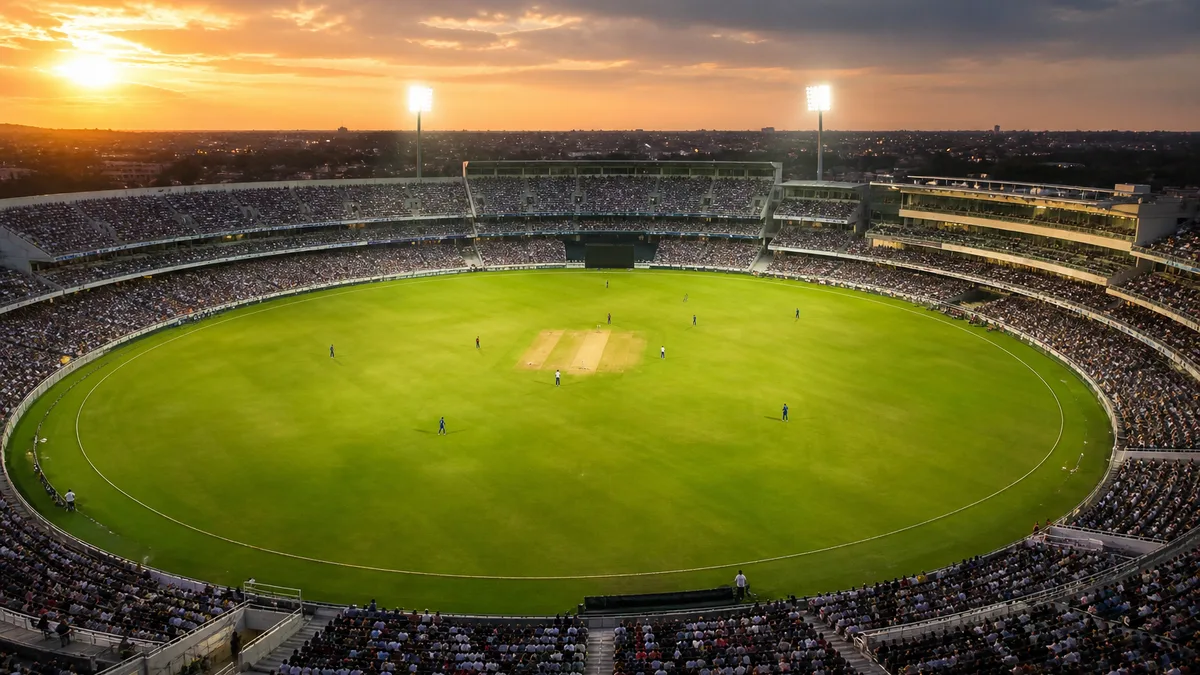
Top 10 Largest Cricket Grounds in the World by Capacity
The world's 10 largest cricket grounds ranked by regular spectator capacity, with current figures, locations, opening dates and notable matches.
Most Sixes in Cricket History: International Record Explained
Rohit Sharma leads the men's international sixes list. See why the total must be separated by format, cutoff date and official record definition.
Lowest Team Scores in Cricket History: Test, ODI and T20I Records
New Zealand's 26 is the men's Test low, ODI records include 35 twice and Ivory Coast's 7 is the men's T20I low. Formats stay separate here.