Meaning of Sledging in Cricket: Banter, Abuse and Rules
On this page9
- 01What is sledging in cricket?
- 02Is sledging legal in cricket?
- 03Banter, sledging and abuse compared
- 04How Law 42 applies to verbal conduct
- 05Discriminatory sledging is prohibited
- 06Why players use sledging
- 07Who is responsible for player behaviour?
- 08How should players respond to sledging?
- 09Sledging is not part of the scorecard
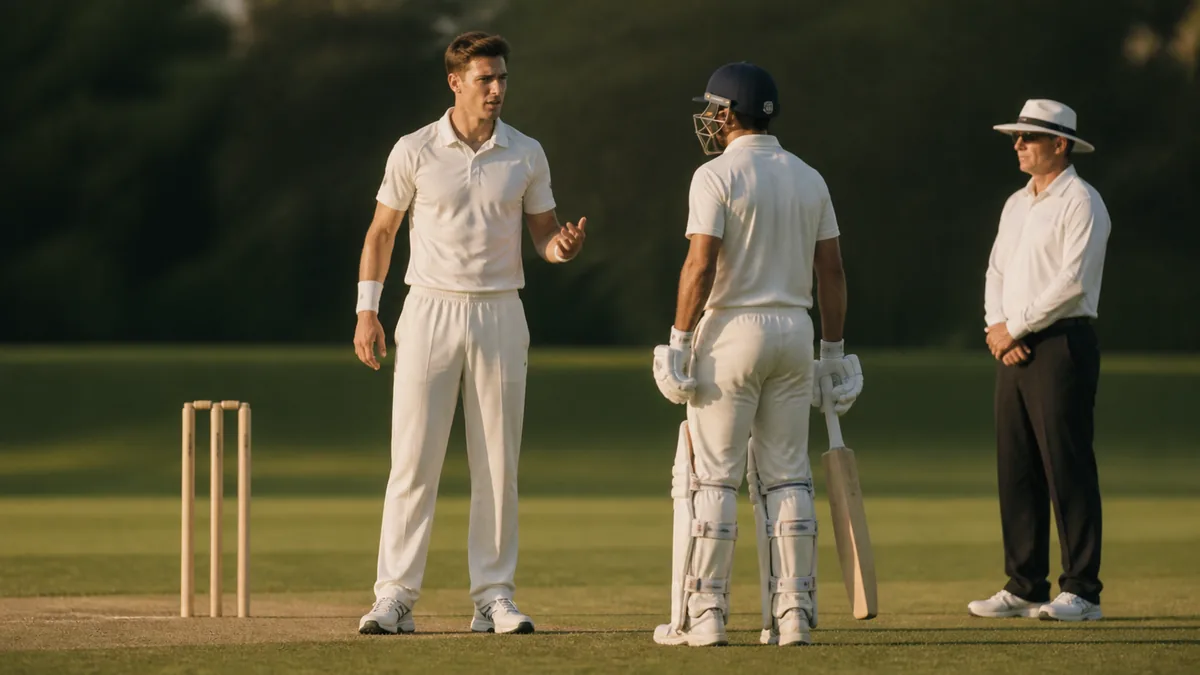
In cricket, sledging means using words, sounds or gestures to distract, unsettle or provoke an opponent. It can describe light competitive talk, but it also covers conduct that becomes personal or abusive. The word is informal; it does not protect a player from the Laws or disciplinary codes.
What is sledging in cricket?
Sledging is a psychological tactic. A fielder, bowler or batter says or does something intended to affect the opponent’s concentration, confidence or decision-making.
Typical aims include:
- tempting a batter into an aggressive shot;
- making a bowler change a successful plan;
- projecting confidence after a difficult passage;
- increasing pressure during a close contest;
- provoking an emotional response that replaces clear judgment.
Not every on-field conversation is sledging. Players discuss tactics, encourage teammates and sometimes exchange friendly remarks. The defining feature is the attempt to influence an opponent rather than communicate ordinary match information.
Is sledging legal in cricket?
There is no Law that says “sledging is allowed.” The Laws judge the actual language, gesture or behaviour. Mild talk may not reach the threshold for misconduct, while offensive or threatening speech can trigger immediate action.
MCC Law 42 places unacceptable conduct into four levels. It includes obscene, offensive or insulting language at Level 1; seriously insulting language directed at a player, official or spectator at Level 2; threats of assault at Level 3; and violence at Level 4.
International cricket adds the ICC Code of Conduct and Anti-Discrimination Code. A remark can therefore lead to an on-field response, a later disciplinary charge, or both. The ICC full-form and governance guide explains how the international body differs from MCC, which writes the Laws.
Banter, sledging and abuse compared
| Conduct | Purpose or character | Likely treatment |
|---|---|---|
| Tactical talk | Team communication or encouragement | Normal play |
| Mutual banter | Light exchange accepted by both players | Often tolerated, context matters |
| Sledging | Deliberate attempt to unsettle an opponent | May be tolerated or sanctioned |
| Personal abuse | Insult aimed at the person rather than play | Likely misconduct |
| Threat | Language or gesture threatening assault | Serious Law 42 offence |
| Discrimination | Attack based on a protected characteristic | Prohibited under ICC code |
The boundary is not a list of approved words. Tone, repetition, target, cultural meaning, match context and whether spectators can hear the remark all matter. What one player considers a joke can still be unacceptable conduct.
How Law 42 applies to verbal conduct
Law 42 gives umpires a graduated response.
| Level | Relevant verbal example | On-field consequence in the Law |
|---|---|---|
| 1 | Obscene, offensive or insulting language | First and final team warning; later offence brings five penalty runs |
| 2 | Language of a seriously insulting nature directed at someone | Five penalty runs and report |
| 3 | Threatening to assault a player or another person | Player suspension plus five penalty runs |
| 4 | Threatening an umpire or committing violence | Removal from the field plus five penalty runs |
Officials can delay calling dead ball until doing so will not disadvantage the non-offending side. They then consult, decide the level and report the incident to the relevant governing body.
Competition regulations can impose additional sanctions after the match. That is why an exchange that appears to pass during play can still produce demerit points, a fine or suspension later.
Discriminatory sledging is prohibited
Race, religion, culture, colour, descent, nationality, ethnic origin, sex, gender, sexual orientation, disability, marital status and maternity status are among the characteristics protected by the ICC Anti-Discrimination Code.
Language or gestures likely to offend, insult, humiliate, intimidate, threaten, disparage or vilify someone on one of those grounds can amount to an offence. Calling it humour, banter or sledging does not change that rule.
This is a firm line rather than an area for tactical judgment. A competitive sport can permit pressure without accepting discrimination.
Why players use sledging
Batting and bowling depend on repeated decisions under time pressure. A small lapse in attention can produce a false shot, missed length or poor fielding choice. Sledging tries to create that lapse without changing the delivery itself.
The tactic may work when an opponent becomes angry and abandons a sound plan. It can also fail badly:
- the opponent becomes more focused;
- the speaker loses concentration;
- teammates become distracted;
- the umpire intervenes;
- the exchange damages the team’s reputation;
- a charge changes selection for later matches.
There is no scorecard statistic proving that sledging caused a wicket. Claims about its effectiveness are usually interpretation, not measurable fact.
Who is responsible for player behaviour?
Every player is responsible for personal conduct. Captains also carry a wider duty to keep the match within the Laws and Spirit of Cricket, and umpires decide when behaviour requires on-field action.
The MCC preamble says cricket should be played within both the Laws and the Spirit of the Game. That matters because a remark can be technically below a formal charge threshold while still damaging respect between opponents.
At international level, umpires and match referees handle reports under ICC procedures. Domestic boards and local leagues use their own codes, which may be stricter than the minimum Law 42 framework.
How should players respond to sledging?
A player does not have to answer. Practical responses include stepping away before the next ball, returning attention to a routine, speaking through the captain, or asking the umpire to intervene if conduct is persistent or abusive.
Retaliation can create a second offence and make the original incident harder to resolve. Captains should document serious allegations promptly, particularly when discrimination or threats are involved.
Young and recreational players should follow their league’s safeguarding and conduct process rather than imitate televised confrontations. The cricket rules hub provides the wider Law structure, while the meaning of slogger explains another informal cricket label that is often used too loosely.
Sledging is not part of the scorecard
Sledging is neither a formal position nor one of the ten methods of dismissal in cricket. A scorecard will not record that a batter was distracted before getting out. It records the runs, delivery and dismissal that followed.
That distinction keeps analysis honest. Players may believe an exchange changed the contest, but the Laws act on the conduct itself rather than trying to prove its psychological effect.
Frequently asked questions
What does sledging mean in cricket?+
Sledging means using words, sounds or gestures to distract, unsettle or provoke an opponent during a match. It ranges from competitive banter to personal abuse, so the label alone does not decide whether conduct is acceptable.
Is sledging allowed in cricket?+
There is no rule granting permission to sledge. Mild competitive talk may pass without sanction, but Law 42 and competition codes prohibit language that is obscene, offensive, insulting, seriously abusive, threatening or discriminatory.
Can a player be fined for sledging?+
Yes. Match officials can report misconduct, and international players may receive demerit points, fines or suspensions under the ICC Code of Conduct. On-field Law 42 penalties can also include warnings, five penalty runs and suspension from play.
Is sledging the same as banter?+
Not exactly. Banter usually suggests mutual or light competitive talk. Sledging specifically aims to affect an opponent and may be one-sided. Either can cross into misconduct when it becomes insulting, threatening, persistent or discriminatory.
Is racial sledging ever allowed?+
No. Conduct based on race, religion, culture, colour, descent, nationality, ethnic origin, sex, gender, sexual orientation, disability and other protected characteristics is prohibited by the ICC Anti-Discrimination Code.
Why do cricket players sledge?+
Players may try to break concentration, draw an impulsive shot, project confidence or change the emotional balance of a contest. The tactic can backfire by motivating the opponent, distracting the fielding side or producing a conduct charge.
Sources
Related rules & terms guides
View all →
Bowling Spell Meaning in Cricket: Overs, Rest and Scorecards
A bowling spell is the continuous block of overs a bowler delivers before leaving the attack. Learn how spells appear in strategy and scorecard analysis.
Slogger Meaning in Cricket: More Than a Big Hitter
A slogger hits hard to score quickly, often with limited control. Learn how sloggers differ from power hitters, finishers and technically attacking batters.

Cricket Abbreviations and Full Forms: The Complete List
Every cricket abbreviation and its full form: ODI, LBW, DRS, DLS, NRR, SR, ER, TBC, TBD, RSA, DNB, c&b, st and more, grouped by where you see them.

ICC Full Form in Cricket: What It Stands For and Does
ICC full form in cricket is International Cricket Council, the global governing body based in Dubai. Here is what it runs and what it does not control.
What Is an Appeal in Cricket? The Umpire’s Decision
An appeal is the fielding side asking an umpire to decide whether a batter is out. Under Law 31, an umpire normally cannot give a batter out without an appeal, except where the Law provides otherwise.

Cricket Ball Colours: Red, White and Pink Explained
Red, white and pink balls are used in different match conditions. The choice affects visibility and durability, while the competition’s playing conditions decide which ball is supplied.