Slogger Meaning in Cricket: More Than a Big Hitter
On this page8
- 01What does slogger mean in cricket?
- 02What is a slog shot?
- 03Slogger versus power hitter, finisher and pinch hitter
- 04Is every fast-scoring batter a slogger?
- 05Slog and slog sweep are not the same shot
- 06When does slogging make tactical sense?
- 07Why sloggers often get caught on the leg side
- 08Is slogger an official batting position?
In cricket, a slogger is a batter who tries to score quickly by swinging hard and playing high-risk attacking shots, often with less control or technical precision. The term is informal and frequently critical. A batter does not become a slogger simply by hitting sixes or maintaining a high strike rate.
What does slogger mean in cricket?
Cambridge Dictionary describes a cricket slogger as a player who hits the ball hard, often in an uncontrolled way. Merriam-Webster gives the broader definition of a hard-hitting cricketer, while ESPN’s cricket glossary calls the player an “exponent of the slog.”
Those definitions share two elements:
- the batter’s immediate aim is fast scoring;
- forceful strokes take priority over careful placement or prolonged defence.
The second element gives the word its edge. Commentators may praise a useful burst of hitting but still call the method a slog. Calling the player a slogger can suggest that the same approach defines most of their batting.
What is a slog shot?
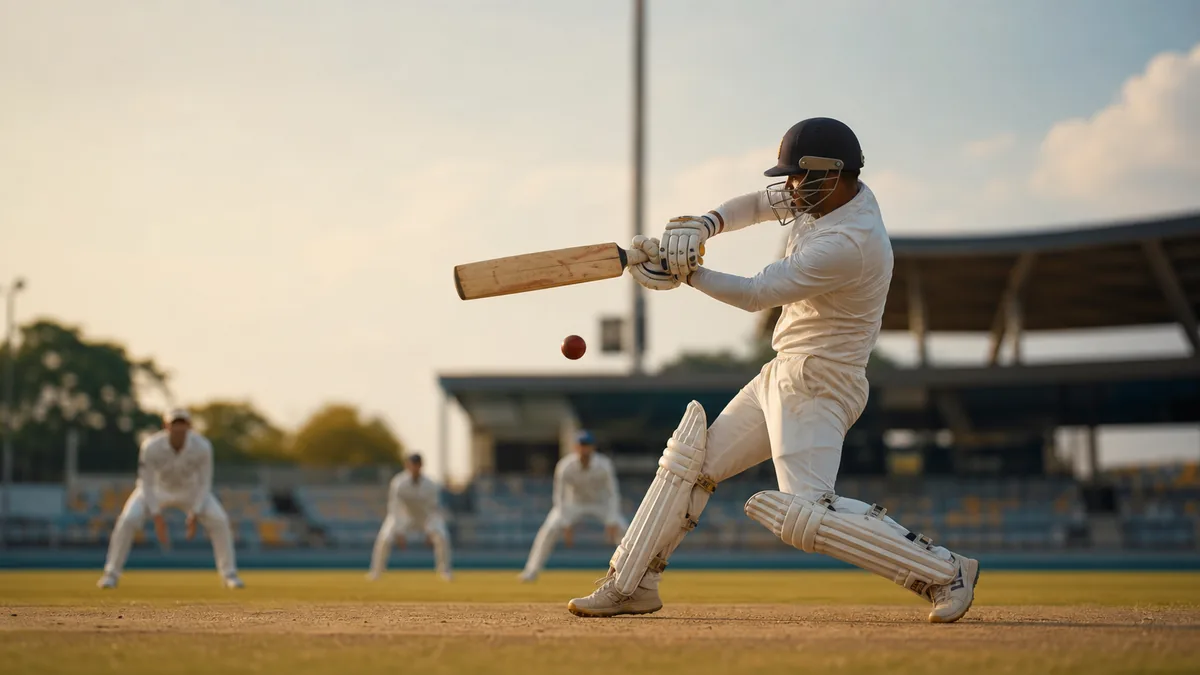
A slog is a forceful shot designed to reach or clear the boundary. The typical version uses a large, cross-batted swing and sends the ball toward midwicket or the wider leg side. The batter may sacrifice a still head, compact swing or precise footwork to generate power.
That creates several common outcomes:
- a boundary when the batter makes clean contact;
- a top edge or skier when the bat gets under the ball;
- a catch at deep midwicket or long-on;
- a bowled dismissal when the swing misses a straight ball;
- a dot ball when timing fails.
The shot is not automatically poor. When only a few balls remain and the team needs quick runs, accepting a higher dismissal risk can be the correct decision.
Slogger versus power hitter, finisher and pinch hitter
These terms overlap, but they describe different things.
| Term | What it describes | Does it imply poor control? |
|---|---|---|
| Slogger | A forceful, high-risk batting style | Often, depending on context |
| Power hitter | A batter able to strike the ball long and hard | No |
| Finisher | A batter trusted to complete an innings or chase | No |
| Pinch hitter | A player promoted for a short tactical attack | No |
| Attacking batter | A player who looks to score and pressure bowlers | No |
A pinch hitter could attack with conventional drives and pulls rather than slogging. A finisher may spend several overs rotating the strike before choosing the right balls to hit. A power hitter can use strength without losing balance or control.
Slogger is the only label in the table that commonly judges the quality of the method. That is why it should be used carefully.
Is every fast-scoring batter a slogger?
No. Strike rate shows how quickly a batter scored, not how they did it. Two players can score 40 from 20 balls through very different methods.
One might select length early, hit gaps, run hard and punish loose balls with several practiced shots. Another might swing across nearly every delivery and depend on power. The scorecard gives both a strike rate of 200, but only the second approach fits the usual meaning of slogging.
Useful distinctions include:
- shot range: can the batter score around the ground or mainly through one arc?
- ball selection: do they attack suitable deliveries or swing regardless of line and length?
- control: how often do intended shots reach safe areas?
- adaptability: can they defend, rotate strike or change pace when conditions demand it?
- repeatability: is the scoring method built on practiced technique or low-percentage contact?
None of these qualities can be proved by a single innings. Describing a living player as a slogger requires more evidence than a short highlight clip.
Slog and slog sweep are not the same shot
The slog sweep is a named stroke, normally used against spin. The batter gets low and swings the ball toward midwicket or square leg. It is more powerful and aerial than a conventional sweep, but skilled players practice its foot position, bat path and target area.
ICC match coverage regularly identifies successful slog sweeps as deliberate shots. That does not make every player who uses one a slogger. A batter can choose a controlled slog sweep for a specific ball while using conventional technique for the rest of the innings.
The relationship is simple: a slog sweep is one type of attacking shot; slogger is a description of a batter’s broader approach. Our guide to innovative cricket shots places it beside the reverse sweep, switch hit, scoops and other deliberate variations without treating all attacking batting as slogging.
When does slogging make tactical sense?
Slogging is most rational when the value of quick runs exceeds the cost of losing the wicket. Common situations include:
- the final overs of a T20 or ODI innings;
- a steep required run rate in a chase;
- a last-wicket partnership with a stronger batter at the other end;
- a declaration push in a Test match;
- a short match reduced further by rain;
- a deliberate attempt to disrupt a settled spin bowler.
The same swing may be sensible with eight balls left and careless with three hours left. Match format, wickets remaining, target, boundary size and the field all change the calculation. Our T20 World Cup history and ODI innings guide show how sharply batting time pressure differs between formats. Like sledging, “slogger” is an informal cricket label rather than an official scorecard term.
Why sloggers often get caught on the leg side
The large cross-batted swing naturally sends many slogs toward cow corner, deep midwicket or long-on. Captains can protect those areas with boundary fielders once the batter’s preferred arc becomes clear.
Bowlers then change pace, bowl wider, use a yorker or make the batter reach for the ball. A mistimed hit travels high rather than long, producing the familiar catch near the rope. ICC match reports often describe a missed slog sweep hitting the stumps or a mistimed version finding deep midwicket.
This risk does not make slogging useless. It explains why a successful slogger can change a short passage of play quickly but may struggle when the opposition controls the preferred hitting zone.
Is slogger an official batting position?
No. Cricket teams nominate batters, bowlers, wicketkeepers and captains, but the Laws do not assign “slogger” as an official position. It is commentary language used to describe style.
Scorecards record runs, balls, boundaries, strike rate and the method of dismissal. They do not mark a player as a slogger. For more scorecard language, see the cricket abbreviations and full forms guide and the explanation of how many players are in a cricket team.
Frequently asked questions
Is slogger a compliment in cricket?+
Usually not. It can neutrally describe a hard-hitting role, but it often suggests that the batter relies on power and takes uncontrolled risks. Context and tone decide whether it is praise, criticism or friendly teasing.
What is the meaning of slogger in Hindi?+
In cricket context, slogger can be explained as a तेज़ और ज़ोरदार शॉट खेलने वाला बल्लेबाज़, often implying a batter who swings hard to score quickly and may sacrifice control. Scorecards do not use slogger as an official role.
What is a slog shot in cricket?+
A slog is a forceful attacking stroke, commonly played with a large cross-batted swing toward the leg side. It aims for a boundary rather than precise placement and carries a higher chance of a miss, edge or catch.
Is a slog sweep the same as a slog?+
No. A slog sweep is a specific sweeping shot, usually played on one knee against spin toward deep midwicket or square leg. Slog is a broader term for forceful, high-risk hitting. A skilled batter can play a controlled slog sweep without being a slogger.
Is every T20 power hitter a slogger?+
No. A power hitter may combine strength with balance, shot selection, placement and the ability to adapt. Slogger usually implies that force and risk dominate the method, so strike rate alone cannot justify the label.
What is the difference between a slogger and a pinch hitter?+
Slogger describes a style of batting. Pinch hitter describes a temporary tactical role, usually a batter promoted to attack early. A pinch hitter may use orthodox shots, while a slogger may bat in any position.
Sources
Related rules & terms guides
View all →
Bowling Spell Meaning in Cricket: Overs, Rest and Scorecards
A bowling spell is the continuous block of overs a bowler delivers before leaving the attack. Learn how spells appear in strategy and scorecard analysis.
Innovative Shots in Cricket: Scoop, Switch Hit and More
Learn the main innovative cricket shots, how each one works, which field gap it targets, and the differences between scoops, sweeps and switch hits.

Meaning of Sledging in Cricket: Banter, Abuse and Rules
Sledging means using words or gestures to unsettle a cricket opponent. Learn what may be tolerated, what breaks Law 42 and how serious abuse is punished.

Cricket Abbreviations and Full Forms: The Complete List
Every cricket abbreviation and its full form: ODI, LBW, DRS, DLS, NRR, SR, ER, TBC, TBD, RSA, DNB, c&b, st and more, grouped by where you see them.

ICC Full Form in Cricket: What It Stands For and Does
ICC full form in cricket is International Cricket Council, the global governing body based in Dubai. Here is what it runs and what it does not control.
What Is an Appeal in Cricket? The Umpire’s Decision
An appeal is the fielding side asking an umpire to decide whether a batter is out. Under Law 31, an umpire normally cannot give a batter out without an appeal, except where the Law provides otherwise.