ODI Full Form in Cricket: Meaning, 50 Overs and Rules
On this page7
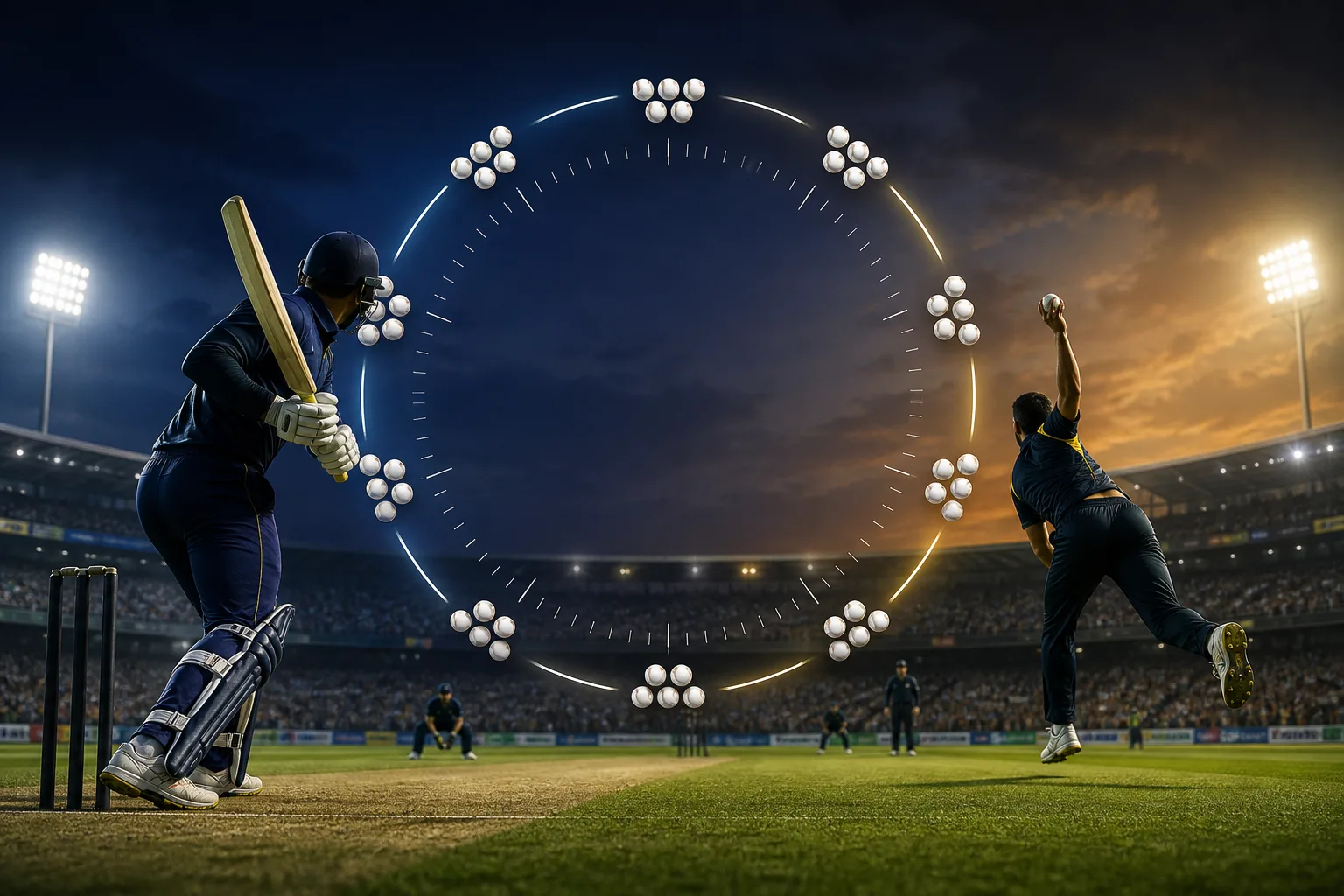
ODI stands for One Day International. It is senior international limited-overs cricket between two national teams with ODI status. Each side normally gets 50 overs, or 300 legal deliveries, and one bowler may send down no more than 10. The format is scheduled for one day, which is the source of its name—not a promise that rain can never push a tournament match onto a reserve day.
What is the full form of ODI in cricket?
The full form is One Day International. “International” matters: a domestic 50-over match follows similar rules but is classified as List A cricket, not an ODI. The ICC decides which national teams have ODI status and defines an ODI as a match between two such teams under its playing conditions.
An ODI gives each team one innings, unlike a Test’s two, and caps that innings at 50 overs, unlike a Test’s unlimited length. It is longer than a 20-over T20 International and is the format used for the ICC Cricket World Cup. The 2027 Cricket World Cup hub explains the next edition’s confirmed format, the 2027 international calendar lists board-confirmed ODIs by month, and the record highest partnerships are tracked by wicket.
How many overs are in an ODI match?
Fifty per innings. The ICC’s ODI playing conditions state that each innings is limited to a maximum of 50 overs and that all matches are of one day’s scheduled duration, with no reserve day for standard bilateral fixtures.
Two details follow from that. If the side batting first is dismissed inside 50 overs, the side batting second still gets its full 50. And if the fielding side fails to complete its 50 overs by the scheduled cut-off, play continues until the overs are bowled rather than the innings being closed early.
| Format | Overs per side | Balls | Max per bowler |
|---|---|---|---|
| ODI | 50 | 300 | 10 |
| T20I | 20 | 120 | 4 |
| Test | No limit | No limit | No limit |
| List A domestic | Usually 50 | 300 | 10 |
The absence of an over limit is the defining difference with the longer format, which our guide to what a Test match is works through in full.
To see the formats separated in live national calendars, the Pakistan men’s schedule, Pakistan Women’s schedule, India men’s schedule, India Women’s schedule, Australia men’s schedule, Australia Women’s schedule, England men’s schedule, England Women’s schedule, South Africa men’s schedule, South Africa Women’s schedule, New Zealand men’s schedule, New Zealand Women’s schedule, Sri Lanka men’s schedule, Sri Lanka Women’s schedule, Ireland Women’s schedule, Bangladesh men’s schedule and Bangladesh Women’s schedule label every verified match as a Test, ODI or T20I and give official start times in PKT when they have been announced.
The Zimbabwe Women’s schedule also separates its five upcoming T20Is from the six completed ODIs and T20Is in Pakistan, rather than mixing formats in one unlabeled feed.
The same separation matters in the Thailand Women’s schedule: Thailand drew a two-match T20I series in Papua New Guinea, then swept the three ODIs 3-0. Combining those five results into one format record would hide what actually changed between the two legs.
How many overs can one bowler bowl?
Ten, and the arithmetic behind it is one-fifth of the innings. The playing conditions say no bowler shall bowl more than 10 overs in an innings, and in a delayed or interrupted match no bowler may exceed one-fifth of the total overs allowed. The quota applies to the player, not a specialist label, so a wicketkeeper who changes roles may bowl within the same limit.
When the reduced total does not divide by five, one extra over is allowed to as many bowlers as needed to make up the balance. A 32-over innings, for example, gives a base of six overs each with two bowlers permitted seven. If a bowler breaks down mid-over, another bowler completes it, and that part-over counts as a full one against only the original bowler’s limit.
This is why an ODI side needs at least five bowling options rather than four. The knock-on effect on selection is covered in how many players are in a cricket team.
Why ODIs were 60 overs until 1987
The first World Cups were 60-over tournaments because they were played in England, where midsummer daylight stretches past 9pm. Fitting 120 overs into a single day was straightforward there.
The very first ODI, at the MCG on 5 January 1971, was not 50 or 60 overs at all: it was 40 eight-ball overs a side, a total of 320 deliveries. Formats stayed local for years, with 40 and 35 eight-ball overs used in Australia and New Zealand and 40 six-ball overs in Asia. The 1975, 1979 and 1983 World Cups settled on 60 overs.
When the 1987 tournament moved out of England for the first time, co-hosted by India and Pakistan, the shorter subcontinental day made 120 overs impossible to schedule. The cut to 50 overs a side was a practical fix, and it became the global standard.
| Period | Overs per side | Context |
|---|---|---|
| 1971 | 40 (eight-ball) | First ODI, Melbourne |
| 1975-1983 | 60 | The three World Cups staged in England |
| 1987 onwards | 50 | Reduced for the India and Pakistan World Cup, kept ever since |
What happens when rain shortens an ODI
Overs are removed and the target is recalculated by the Duckworth-Lewis-Stern method. Both sides must have had the opportunity to bat for at least 20 overs for a result to stand.
DLS treats a batting innings as two depleting resources: balls remaining and wickets in hand. It works out what proportion of those resources each side actually had access to and adjusts the target so the chase asks the same of the second team as the first team faced. That is why losing wickets, not just overs, moves the number, and why a rain break can leave a chasing side needing more runs from fewer balls than the raw run rate suggests.
The exceptions to the 20-over rule are the obvious ones. A side bowled out inside 20 overs still produces a valid result, as does a chase completed before 20 overs are up. If the innings is cut to fewer overs, the powerplay blocks and the per-bowler cap scale down with it. In a tied match, the Super Over tie-breaker settles it.
How the 50 overs split into powerplays
The 50 overs are divided into three fielding-restriction blocks, and only the middle one gives the bowling side much room.
| Powerplay | Overs | Fielders allowed outside the 30-yard circle |
|---|---|---|
| Powerplay 1 | 1-10 | 2 |
| Powerplay 2 | 11-40 | 4 |
| Powerplay 3 | 41-50 | 5 |
The circle itself is two semi-circles of 30 yards (27.43 m) centred on the middle stump at each end, linked by two straight lines. The restriction applies at the instant of delivery, not throughout the over. When an innings is shortened, the playing conditions carry a table that reallocates the blocks: a 20-over innings, for instance, becomes 4, 12 and 4.
These fielding limits also shape batting technique. When fine leg or third man is inside the circle, ramps, scoops and other innovative cricket shots let a batter use the bowler’s pace to reach the unprotected area behind the wicket.
Over rates, penalties and the ball change at over 34
The minimum over rate in an ODI is 14.28 overs per hour, which works out at 50 overs in three and a half hours. Falling behind now costs a side within the match, not just afterwards.
The fielding side must be in position to bowl the first ball of the penultimate over by the scheduled cut-off time for the innings. If it is not, the Powerplay 3 allowance is cut and no more than four fielders may stand outside the circle for the remainder of the innings. The penalty does not apply if the innings has been reduced below 25 overs, unless it had already been imposed, or if the innings finishes before the cut-off. Allowances are given for injury treatment, third-umpire referrals and time-wasting by the batting side.
One further change took effect in July 2025. Two new balls are still used from opposite ends, but only for overs 1 to 34. At the end of over 34, the fielding side chooses one of the two to use for the remaining 16 overs, which gives the older ball a chance to reverse swing in the death overs. In a match reduced to 25 overs or fewer before the first innings starts, each side gets one new ball only.
ODIs use white leather balls for visibility with coloured clothing and under floodlights. The guide to cricket ball types compares white with the red and pink balls used in multi-day cricket.
For the shorthand you will see attached to all of this on a scoreboard, from PP to NRR to DLS, our reference on cricket abbreviations and full forms covers each one, and the body setting these conditions is explained in what ICC stands for in cricket.
Frequently asked questions
What is the full form of ODI in cricket?+
ODI stands for One Day International. It is a senior international limited-overs match between two teams with ODI status, normally played as one innings of 50 overs per side in a single day.
How many overs are there in an ODI match?+
Fifty per side, so 100 overs in a full match. Each innings is capped at 50 overs or 300 legal deliveries, whichever comes first, and the side batting second gets its full 50 even if the first innings ended early.
How many overs can one bowler bowl in an ODI?+
Ten. The ICC playing conditions cap a bowler at 10 overs in a 50-over innings. In a rain-reduced match the cap becomes one-fifth of the total overs, with one extra over allowed to the necessary number of bowlers when the total does not divide by five.
Why were ODIs 60 overs before?+
The first three World Cups, in 1975, 1979 and 1983, were played in England in midsummer, where long daylight hours allowed 120 overs in a day. When the 1987 tournament moved to India and Pakistan, shorter days forced the reduction to 50 overs a side, and it stuck.
What is the minimum number of overs for an ODI result?+
Twenty per side. Unless both teams have had the chance to bat for at least 20 overs, the match is a no result, with the exceptions that a side bowled out in fewer than 20 overs still counts, as does a chase completed early.
How does DLS decide a rain-affected ODI?+
DLS treats overs remaining and wickets in hand as two combined resources. When rain removes overs, it works out what percentage of resources each side had, and resets the target in proportion. Losing wickets shrinks the resource as much as losing overs, which is why a target can rise after a delay.
What are the powerplay overs in a 50-over match?+
Three blocks. Powerplay 1 is overs 1 to 10 with a maximum of two fielders outside the 30-yard circle. Powerplay 2 is overs 11 to 40 with four. Powerplay 3 is overs 41 to 50 with five. In a shortened innings the blocks scale down on a set table.
What happens if a team bowls its overs too slowly in an ODI?+
The minimum over rate is 14.28 overs an hour. If the fielding side is not ready to bowl the first ball of the penultimate over by the scheduled cut-off, only four fielders instead of five may stand outside the circle for the rest of the innings, on top of any code-of-conduct sanction.
How many balls are in an ODI innings?+
Three hundred legal deliveries, being 50 overs of six balls each. Wides and no-balls do not count towards the six and have to be bowled again, so an innings with plenty of extras uses more than 300 actual deliveries while still being exactly 50 overs long.
Sources
- ICC: ODI definition in the official playing conditions
- ICC Men's One Day International Playing Conditions, effective July 2025
- ICC: Playing conditions library
- ICC: Several changes made to ICC playing conditions (two new balls to over 34)
- ESPNcricinfo: The evolution of ODI cricket
- ESPNcricinfo: How the Duckworth-Lewis-Stern method works
- ESPNcricinfo: ICC slow over-rate penalty extended to ODIs
Related rules & terms guides
View all →
Cricket Abbreviations and Full Forms: The Complete List
Every cricket abbreviation and its full form: ODI, LBW, DRS, DLS, NRR, SR, ER, TBC, TBD, RSA, DNB, c&b, st and more, grouped by where you see them.
What Is a Test Match in Cricket? The 5-Day Format
A Test match is cricket's five-day format: two innings a side, no over limit, a draw if nobody wins. The rules, Test status and the WTC explained.

T20 World Cup Winners List 2007 to 2026: Every Champion
Complete T20 World Cup winners list from 2007 to 2026 with runners-up, hosts, final margins and players of the tournament, plus the women's champions.
What Is an Innings in Cricket? Meaning and Rules
An innings is one team's turn to bat, or one batter's time at the crease. Learn how innings work in Tests, ODIs and T20s and the five ways they end.

ICC Full Form in Cricket: What It Stands For and Does
ICC full form in cricket is International Cricket Council, the global governing body based in Dubai. Here is what it runs and what it does not control.
India Women vs Thailand Women: Result & How to Watch
India Women beat Thailand Women by 94 runs on 30 August 2026. See the score, key performances and archived legal viewing details by country.