What Is an Innings in Cricket? Meaning and Rules
On this page9
- 01What is an innings in cricket?
- 02Is it inning or innings?
- 03How many innings are in each cricket format?
- 04What happens during a team’s innings?
- 05Five ways a team innings can end
- 06How innings work in Test cricket
- 07Team innings versus batter innings
- 08What does “won by an innings” mean?
- 09Simple innings examples
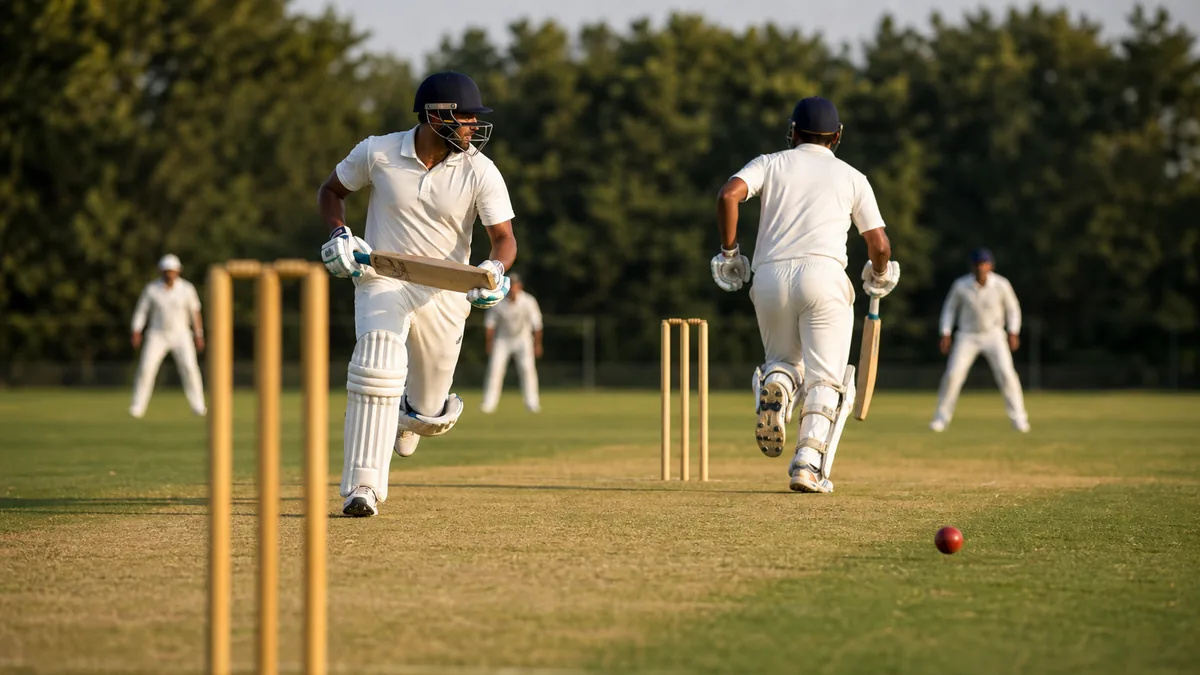
An innings is one team’s turn to bat and score runs while the other team bowls and fields. The same word can also describe one batter’s time at the crease. Each team receives one innings in an ODI or T20 and up to two innings in a Test match.
What is an innings in cricket?
At team level, an innings begins when the first ball is called for play and continues until the batting turn is completed. The team adds runs to one total, loses wickets and sends in new batters as dismissals occur.
At player level, a batter’s innings begins when that player comes to the crease and ends on dismissal, retirement or the end of the team’s innings. “She played an innings of 75” means the player scored 75 runs, not that the whole team did.
The context normally makes the meaning clear:
- India scored 280 in its innings: the team total.
- The opener played a patient innings: one player’s performance.
- The third innings changed the Test: the third team batting turn in match order.
Is it inning or innings?
Cricket uses innings for both singular and plural. One team has one innings; in a Test it may have two innings. “Inning” without the final s belongs to baseball usage and is not the standard cricket term.
The grammar sounds unusual because the word already ends in s. The verb shows the number: “the innings is over” for one and “both innings are complete” for two.
How many innings are in each cricket format?
| Format | Innings per team | Total possible | Over limit per innings |
|---|---|---|---|
| Test match | 2 | 4 | None |
| First-class match | Usually 2 | 4 | Usually none |
| ODI | 1 | 2 | 50 overs |
| List A | 1 | 2 | Usually 50 overs |
| T20 | 1 | 2 | 20 overs |
| The Hundred | 1 | 2 | 100 balls |
“Possible” matters in Tests. A team may win a chase before all four innings are completed, or win by an innings without batting a second time. Time can expire and produce a draw with an innings still open.
Our Test match guide explains the five-day structure, while the ODI overs guide covers the 50-over limit and rain reductions.
The Pakistan cricket team schedule, India cricket team schedule, South Africa cricket team schedule, New Zealand cricket team schedule, Sri Lanka cricket team schedule and Bangladesh cricket team schedule provide current examples of all three international formats, with each fixture labelled Test, ODI or T20I and recent results kept apart from future matches.
What happens during a team’s innings?
Two batters occupy the wickets. One faces the delivery as the striker and the other waits at the opposite end as the non-striker. They exchange ends by completing runs, and normally swap roles at the end of an over.
The fielding side uses its bowlers and fielders to restrict scoring and take wickets. When a batter is dismissed, the next member of the nominated eleven comes in. The batting side’s total combines batter runs, extras and penalties until the innings closes. Runs scored while two batters are together form a partnership; the largest World Cup partnerships show how one stand can shape an entire innings. At the other end of the scoreboard spectrum, lowest team scores in cricket show how quickly an innings can collapse.
Every member of the eleven is eligible to bat, but an all-out innings normally records only ten dismissals. The eleventh player remains not out because a batter cannot continue alone. The cricket team-size guide explains substitutes and why they cannot simply replace an injured batter.
Five ways a team innings can end
MCC Law 13 lists the conditions for a completed innings.
- The side is all out. Ten wickets have fallen and only one batter remains.
- No further batter is available. A wicket falls or a batter retires, and injuries or absences leave nobody able to join the survivor.
- The captain declares. In a format that permits declarations, the captain voluntarily closes the innings to create more time to dismiss the opposition.
- The captain forfeits. The side gives up an innings before it starts under Law 15.
- The agreed limit expires. The allotted overs or time ends, as with 20 overs in T20 or 50 in an ODI.
A successful chase also concludes the match as soon as the target is passed. The chasing side does not continue merely to use every scheduled ball.
How innings work in Test cricket
A Test permits two innings per team. The ordinary order is:
- Team A first innings
- Team B first innings
- Team A second innings
- Team B second innings
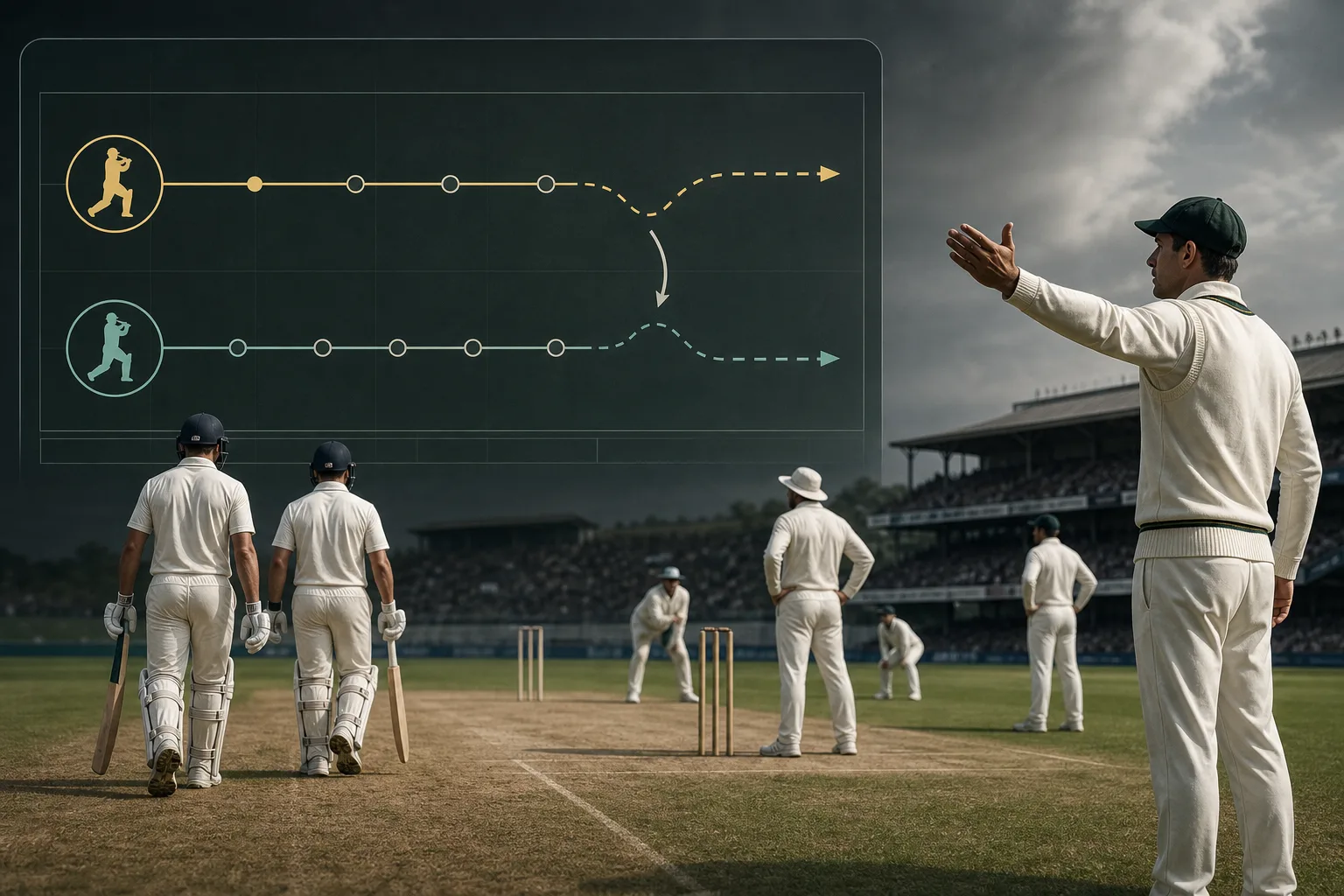
The follow-on can change that order. If Team A bats first and leads by at least 200 after the first innings in a five-day match, its captain may require Team B to bat again immediately. Team B then plays consecutive innings before Team A decides whether a chase is needed. The full thresholds and tactics are in the follow-on guide.
Declarations help create a result when batting indefinitely would use too much of the five-day limit. A captain balances extra runs against the time needed to take the remaining wickets.
Team innings versus batter innings
| Phrase | Meaning |
|---|---|
| Team innings | The complete period in which one side bats |
| Batter’s innings | One player’s uninterrupted batting performance |
| First innings | Each side’s first batting turn, or the first turn in match sequence depending on context |
| Second innings | A side’s second turn in a two-innings match |
A batter can finish not out while the team innings is complete. This happens when the overs expire, the captain declares, the target is reached or the other ten players are dismissed.
Individual innings feed batting averages. Runs are divided by the number of times the player was out, not simply the number of innings played. That is why a not-out score affects the calculation differently from a dismissal.
What does “won by an innings” mean?
An innings victory occurs when one side’s single total exceeds everything the opponent scored across both batting turns. The winner does not need a second innings.
Suppose Team A scores 400. Team B makes 180, follows on and scores 190. Its combined score is 370, still 30 short of Team A. The result is Team A won by an innings and 30 runs.
This result exists only in two-innings cricket. An ODI or T20 winner is described by runs, wickets, a tie-break or another competition result because each side bats once.
Simple innings examples
| Match situation | What ends the innings? | Score notation |
|---|---|---|
| ODI side reaches 275/8 after 50 overs | Over limit | 275/8 |
| T20 chasing side passes 161 in 18.4 overs | Target reached and match won | 162/5 |
| Test captain stops at 450/6 | Declaration | 450/6 declared |
| Ten batters are dismissed for 210 | All out | 210 |
| Batter is injured and cannot return | Player innings ends retired hurt | Individual score marked retired hurt |
An individual retirement does not always complete the team’s turn. Another batter may replace the retired player. Our retired-out explainer distinguishes tactical retirement from leaving through injury.
The simplest way to follow any scorecard is to ask two questions: which team’s innings is this, and how can it end? Once those are clear, overs, wickets, declarations and targets fit into the same structure.
Frequently asked questions
What does innings mean in cricket?+
An innings is one team's turn to bat and score runs while the other team bowls and fields. The word also describes an individual batter's uninterrupted time at the crease, from coming in until dismissal or the team innings ends.
Is innings singular or plural?+
Both. Cricket uses one innings and two innings; the word does not lose its final s in the singular. 'Inning' is standard in baseball but not in cricket.
How many innings are there in cricket?+
An ODI or T20 has two team innings in total, one per side. A Test match allows two innings per side, four in total, although a chase, declaration, follow-on, draw or innings victory may mean not all four are completed.
How long is one innings in cricket?+
A T20 innings is limited to 20 overs and an ODI innings to 50. A Test innings has no fixed over limit and can continue until it is completed, declared or the match runs out of time.
Why does a cricket innings end after 10 wickets?+
Batting requires two players at the wicket. Once ten of an eleven-player side are out, the remaining not-out batter has no partner, so the team is all out. An innings can finish earlier if no further batter is available.
What does winning by an innings mean?+
It means a team scored enough in its one completed innings to beat the opponent's combined total from both innings. For example, 400 against 180 and 190 is a win by an innings and 30 runs.
Sources
Related rules & terms guides
View all →
What Is a Test Match in Cricket? The 5-Day Format
A Test match is cricket's five-day format: two innings a side, no over limit, a draw if nobody wins. The rules, Test status and the WTC explained.

ODI Full Form in Cricket: Meaning, 50 Overs and Rules
ODI means One Day International. Learn its 50-over format, 300 balls, bowler limits, powerplays, DLS rain rules and 60-over history.

Cricket Abbreviations and Full Forms: The Complete List
Every cricket abbreviation and its full form: ODI, LBW, DRS, DLS, NRR, SR, ER, TBC, TBD, RSA, DNB, c&b, st and more, grouped by where you see them.
How Many Wickets Are There in Cricket? Team, Innings and Pitch Explained
Cricket has two physical wickets, 10 dismissals to end a normal innings and 11 players in a side. Here is how each meaning fits together.
What Is Retired Out in Cricket? Law 25 Explained
Retired out means a batter leaves voluntarily and is recorded out. Learn MCC Law 25, whether the batter can return, and how it differs from retired hurt.
What Is the Follow-On in Test Cricket? Law 14 Explained
The follow-on lets a captain make the trailing side bat again. Here are the 200-run rule, the margins for shorter matches, and when enforcing it backfired.